


The fat-burning heart rate zone is a state where your body burns the most fat per minute, typically occurring at 60% to 70% of your maximum heart rate. While higher-intensity workouts burn more total calories, staying in this moderate zone is an excellent, sustainable way to target fat stores directly.
Imagine walking on a treadmill at your local gym. You look down at the bright screen. It shows your pulse. It also shows a colorful chart with different zones. One zone has the label “fat burn.” Another zone has the label “cardio.” You wonder which one is best for your goals. Should you walk slow and steady, or should you run as fast as you can?
This is a very common question for anyone who wants to shed some extra weight. The gym screen can be confusing. Many people think they must sweat and gasp for air to lose weight. Others believe that slow movement is the only way to melt away fat. The truth is actually a mix of both science and smart planning.
In this guide, we will look closely at how your body uses energy. You will learn the science behind your heart beats. We will show you how to find your personal target numbers. You will also discover the best exercises to reach your goals. Let us dive in and clear up the confusion about weight loss.
Key Takeaways
- Target Zone: The fat-burning zone is 60% to 70% of your maximum heart rate.
- Fuel Sources: Your body burns a higher percentage of fat at lower intensities and more carbs at higher intensities.
- Easy Math: You can find your maximum heart rate by subtracting your age from 220.
- Best Activities: Brisk walking, light cycling, and easy swimming are perfect for this zone.
- Balance is Key: Combining low-intensity steady-state cardio with high-intensity workouts gives the best results.
- Simple Tracking: You can use a smart watch or the basic “talk test” to monitor your effort.
📑 Table of Contents
Understanding Your Heart Rate Zones
Your heart is a very special pump. It beats all day and all night. When you sit still, it beats slowly. When you start to move, it beats faster. This happens because your muscles need more energy. Your muscles need oxygen to work. Your blood carries this oxygen to them.
When you exercise, you can measure how fast your heart beats. This is called your heart rate. It is measured in beats per minute, or bpm. By tracking this number, you can see how hard your body is working.
The Five Heart Rate Zones
Fitness experts divide heart rates into five distinct zones. Zone one is the easiest. It feels like a slow walk. Your heart beats at 50% to 60% of your maximum speed. Zone two is a bit faster. This is your light workout zone. You can still talk to a friend easily. Zone three is moderate. This is the cardio zone. Your breathing gets deeper here.
Zone four is hard. You will sweat a lot. You can only say a few words at a time. Zone five is your maximum effort. You are running as fast as you can. You can only stay in zone five for a very short time. Each of these zones has a unique job. Some help your heart get stronger. Others help you run faster. One special zone helps you burn body fat.
What Heart Rate Zone Burns Fat?
Now, let us focus on our main topic. What Heart Rate Zone Burns Fat? The magic happens in zone two. This is the official fat-burning zone. In zone two, your heart beats at 60% to 70% of your max rate.
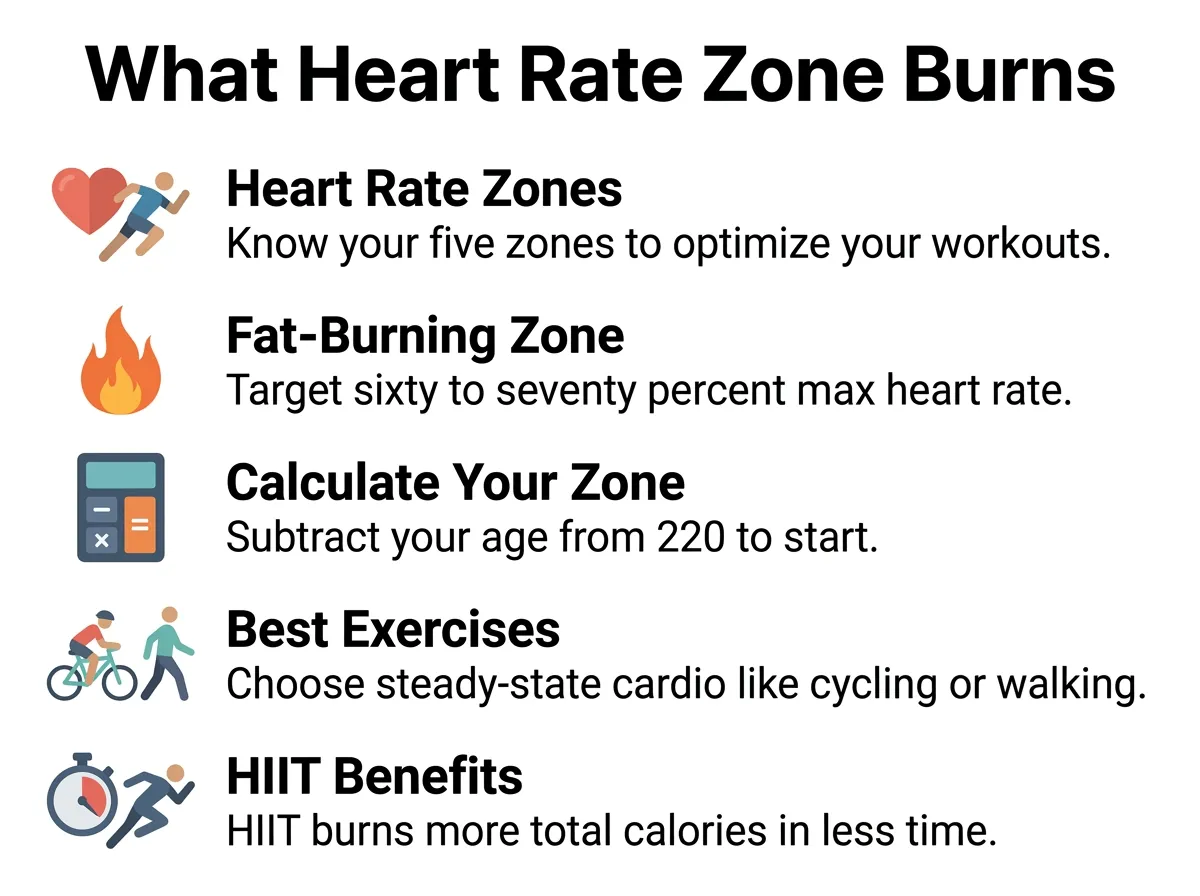
What Heart Rate Zone Burns Fat? — key points at a glance
This pace feels light and easy. You might feel like you are not working hard enough. But do not worry. This is exactly where you want to be. Why is this zone so good for burning fat? The secret is oxygen. Your body needs oxygen to turn fat into energy. In zone two, you breathe easily. This means your body gets plenty of oxygen.
According to the experts at the Cleveland Clinic, this zone keeps your heart rate moderate so you can sustain the workout for a longer time. Since you can go longer, you burn more fat overall. If you go too fast, your body cannot get oxygen quickly enough. When that happens, it stops burning fat and starts burning quick carbs instead.
The Math Behind the Fat-Burning Zone
Let us look at how your body chooses fuel. Your body has two main fuel sources. These are fats and carbs. Fats are slow energy. Carbs are fast energy. When you exercise in zone two, your body has time to burn fat. About 60% of your energy comes from fat. Only 40% comes from carbs.
If you push too hard, your body needs energy fast. It does not have time to break down fat. So, it switches to carbs. This is why high-intensity workouts burn less fat per minute. If you want to target fat directly, you must ask yourself: What Heart Rate Zone Burns Fat? The answer will always point you back to the moderate intensity of zone two.
Fat Burn vs. Cardio Zone
Is the cardio zone bad for weight loss? No, not at all. The cardio zone is zone three. Your heart rate is higher here. In the cardio zone, you burn more total calories. But only about 35% of those calories come from fat.
Think of it this way. In the fat-burning zone, you burn fewer total calories, but more of them are fat. In the cardio zone, you burn more total calories, but less of them are fat. Both zones have a place in your plan. The right choice depends on your daily goals.
How to Calculate Your Personal Fat-Burning Zone
To use this info, you must know your personal numbers. Everyone has a different heart rate. Your zone depends on your age and health. You cannot just use your friend’s numbers.
Step-by-Step Calculation
How do you find your numbers? It is very simple. First, you need to find your maximum heart rate. The easiest way is to use your age. Take the number 220. Now, subtract your age.
Let us do an example. If you are 40 years old, the math is 220 minus 40. Your maximum heart rate is 180 bpm. Second, find the low end of your zone. This is 60% of your max. Multiply 180 by 0.60. You get 108 bpm. Third, find the high end of your zone. This is 70% of your max. Multiply 180 by 0.70. You get 126 bpm.
So, if you are 40, your fat-burning zone is 108 to 126 bpm. You can learn more about how to calculate your numbers on Healthline. This math is a great starting point for most adults.
Best Exercises for the Fat-Burning Zone
Now you know your numbers. How do you get into this zone? You do not need to do hard workouts. Simple, steady movement is best.
Low-Intensity Steady State (LISS) Cardio
LISS is the best workout for this goal. It means moving at a steady pace for a long time. You should aim for 30 to 60 minutes. Walking is the easiest way to do this. Walk fast, but do not run. You can also ride a bike on a flat road. Swimming at an easy pace is another great choice. Many people love the elliptical machine. It is easy on your joints. It helps you keep a steady rhythm.
Daily Activities That Count
You do not have to go to the gym to burn fat. Many daily tasks can get you into zone two. Do you have a dog? Take them for a long, brisk walk. Do you have a yard? Mowing the lawn or pulling weeds is great exercise. Even cleaning your house can work. Sweeping, mopping, and vacuuming require energy. If you move fast, your heart rate will rise. You will burn fat while doing your chores.
High-Intensity Workouts: The Calorie Debate
Some fitness coaches say you should ignore the fat-burning zone. They tell you to do high-intensity workouts instead. This creates a big debate in the fitness world.
The Calorie Debate
High-intensity workouts are fast and hard. You might do sprints or jump rope. These workouts burn a lot of calories in a short time. Research shared by Mass General Brigham shows that while high-intensity workouts burn a lower percentage of fat, they burn more total calories.
Imagine you walk for 30 minutes. You burn 200 calories. Since you are in zone two, 60% of those are fat. That means you burned 120 fat calories. Now, imagine you run fast for 30 minutes. You burn 400 calories. But only 35% of those are fat. That means you burned 140 fat calories. So, the harder workout burned more fat calories in the end because the total calorie count was much higher.
The Afterburn Effect
High-intensity workouts also have a secret weapon. This is the afterburn effect. When you work out very hard, your body gets tired. It takes a long time to recover. Your body must work hard to cool down and repair your muscles. This means you keep burning calories even after you stop. You could be sitting on the couch, and your body is still burning extra energy. So, a good plan uses both easy fat-burning days and hard high-intensity days.
Practical Tips to Track and Stay in Your Zone
Now you have all the facts. How do you put them to use? You need a way to track your heart rate while you move. Fortunately, this is easier than ever.
Wearable Tech
Smart watches are very popular today. Most of them have heart rate monitors on the back. These watches can show you your heart rate in real time. Many of them will even tell you which zone you are in. If you want more accuracy, use a chest strap. This strap wraps around your chest. It measures the electric signals from your heart. It is very precise.
The Talk Test
You do not need to buy expensive gadgets to track your progress. You can use your own voice. This is called the talk test. When you are in zone two, you should be able to carry on a conversation. You can talk to a friend without gasping for air. But you should not be able to sing. If you can sing your favorite song, you are moving too slowly. If you cannot talk at all, you are moving too fast. Slow down until you can speak again.
Conclusion
Losing weight does not have to be painful. You do not need to push your body to its limits every day. When you ask What Heart Rate Zone Burns Fat, the answer is simple. Zone two is your friend. It is easy on your body. It is safe for your joints. Best of all, it works. Try to mix different types of exercise. Walk at a steady pace a few times a week. Add one or two short, hard workouts if you like. Most importantly, choose activities that you enjoy. If you like your workouts, you will keep doing them. Grab your sneakers, track your heart rate, and start your journey today.
Frequently Asked Questions
How do I calculate my max heart rate?
The simplest way to calculate your maximum heart rate is to subtract your age from 220. For example, if you are 30 years old, your estimated maximum heart rate is 190 beats per minute. This number serves as the baseline for finding all your other training zones.
Is walking in the fat-burning zone better than running?
Walking is excellent for targeting a higher percentage of fat because it keeps your heart rate in a moderate zone. However, running burns more total calories in less time, which can also lead to great overall weight loss. The best approach is to include both types of exercise in your weekly routine.
How long should I stay in the fat-burning zone to lose weight?
You should aim to stay in the fat-burning zone for at least 30 to 60 minutes per session. Since this zone is low to moderate intensity, your body can sustain the effort for longer periods without getting exhausted. Doing this three to four times a week will yield the best results.
Can I burn fat without a heart rate monitor?
Yes, you can easily use the “talk test” to estimate your heart rate zone without any special equipment. If you can speak in full sentences but cannot sing while exercising, you are likely in the fat-burning zone. If you are gasping for breath, you have pushed past it into a higher cardio zone.
Why does my body burn carbs instead of fat at high intensities?
At high intensities, your body needs energy very quickly to keep up with the physical demand. Breaking down fat is a slow process that requires a lot of oxygen, which is scarce when you are gasping for air. Therefore, your body switches to burning stored carbohydrates, which can be converted into energy much faster.
Is the fat-burning zone a myth?
The fat-burning zone is not a myth, but it is often misunderstood by fitness beginners. While you do burn a higher percentage of fat in this zone, high-intensity workouts burn more total calories and create an afterburn effect. Both methods are highly effective for weight loss when used correctly.
