



Running burns more total calories per minute, making it highly efficient for weight loss. However, walking burns a higher percentage of calories from fat and is much easier on your joints. Ultimately, the best exercise is the one you can stick with consistently over time.
You stand at your front door. You look down at your running shoes. Then you look at your walking shoes. You want to shed some extra weight and feel good. But your time today is short. You only have thirty minutes. A simple question comes to your mind. Does Walking or Running Burn More Fat?
It is a question that many people ask. We all want the best results for our hard work. Some people love the rush of a fast run. Others like the calm pace of a nice walk. Both feel great. But which one helps your body lose fat faster?
In this guide, we will break down the science of fat loss. We will look at how your body burns energy during exercise. We will explore the pros and cons of both walking and running. By the end, you will know how to plan the perfect workout for your body.
Key Takeaways
- Running burns more calories: It is a high-intensity workout that burns about double the calories of walking in the same time frame.
- Walking target percentage: Walking keeps you in the low-intensity zone, where a higher percentage of fuel comes from fat.
- The “afterburn” effect: Running creates an afterburn effect, meaning you keep burning calories long after the workout ends.
- Joint health: Walking is low-impact and safe, making it ideal for beginners or those recovering from injury.
- Consistency wins: The best exercise for fat loss is the one you enjoy enough to do every week.
📑 Table of Contents
The Fat-Burning Zone: Myth vs. Reality
Many people talk about the fat-burning zone. They say you must keep your heart rate low to burn fat. Is this true? Let us look at how your body uses fuel.
What is the fat-burning zone?
When you move, your body uses two main fuels. It uses fat, and it uses carbohydrates. When you walk, your heart rate stays low. At this low heart rate, your body burns a high percentage of fat for fuel. This state is often called the fat-burning zone. It sounds like the perfect way to lose weight.
Why percentage is not everything
It is true that walking burns a higher percentage of fat than running. But there is a catch. Walking burns fewer total calories. Running is hard work. When you run, your heart rate goes up. Your body burns a lower percentage of fat and a higher percentage of carbohydrates. But because running is hard, you burn many more total calories.
Think of it like money. Would you rather have 60% of a ten-dollar bill, or 30% of a hundred-dollar bill? The smaller percentage of the larger number still gives you more. Running burns more total calories, and that is what leads to real weight loss.
Total Calorie Burn: Why Running Takes the Lead
If your main goal is to burn calories fast, running wins. It is a high-intensity workout. It forces your muscles to work very hard.
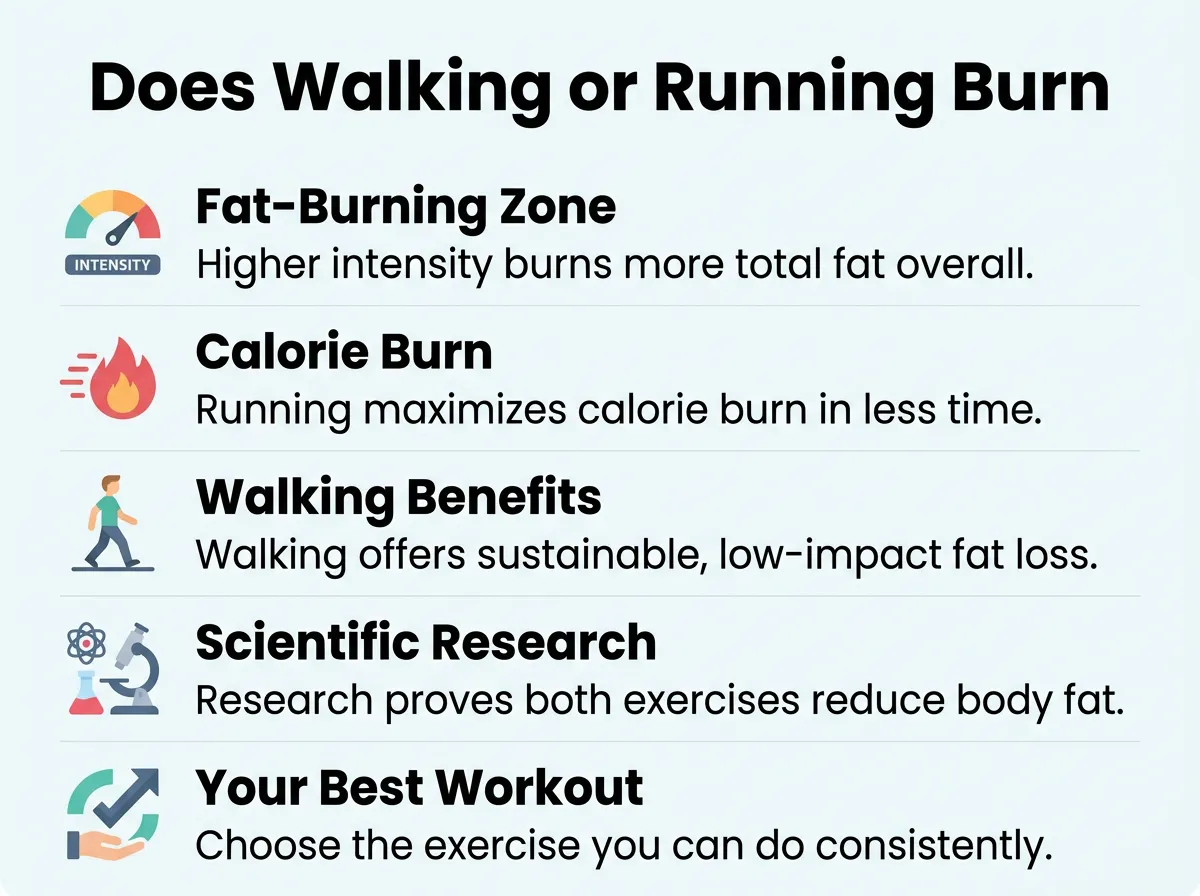
Does Walking or Running Burn More Fat? — key points at a glance
The power of intensity
When you run, you lift your entire body weight off the ground with every step. This takes a lot of effort. A brisk run can burn twice as many calories as a walk in the same amount of time. If you have only thirty minutes, running will help you burn more energy and fat.
The afterburn effect
Running also has a special benefit. It is called excess post-exercise oxygen consumption, or EPOC. People call it the afterburn effect. After a hard run, your body keeps burning calories at a higher rate. It does this to repair your muscles and rest. Walking does not create a big afterburn effect. To understand this better, you can read about the key differences between walking and running.
The Benefits of Walking for Weight Loss
Running burns more calories fast. But that does not mean walking is bad. Walking is one of the best tools for fat loss. It has unique perks that running cannot match.
It is gentle on your joints
Running is a high-impact exercise. It can be hard on your knees, hips, and ankles. Many people get hurt when they start running too fast. Walking is low-impact. It is very safe. You can walk every day without hurting your joints. It is a great way to stay active for life.
It lowers stress and cortisol
Hard workouts can stress your body. When you run too much, your body makes a hormone called cortisol. High cortisol can make your body hold onto fat, especially around your belly. Walking is different. It lowers stress and keeps cortisol low. This makes it easier for your body to release fat. For more tips on this, check out the Mayo Clinic guide on walking for weight loss. It shows how simple steps can add up to big results.
Science Speaks: What the Research Shows
Researchers have studied this topic for years. They wanted to see if walking or running works best over a long time.
The six-year study
One famous study tracked thousands of runners and walkers. It lasted over six years. The results were clear. Both groups lost weight. But the runners lost more weight overall. This is because they burned more energy in less time.
However, the study also found that walking is highly effective if you match the energy used. If you walk long enough to burn the same calories as a run, you get the same health benefits. You can read more about these studies on physical activity and weight online. The key is how much total energy you use, not just how fast you move.
How to Choose the Best Workout for Your Body
You do not have to choose just one. The best choice depends on your fitness level, your joints, and your time.
Choose walking if:
You are new to exercise. Your joints hurt when you jump or run. You have a lot of stress in your life. Or, you just want to enjoy nature at a calm pace. Walking is great because you can do it for a long time without feeling wiped out.
Choose running if:
You are already fit. You want to build a strong heart fast. You want to save time. If you only have twenty minutes, a quick run is a great choice. It gets your heart rate up and burns lots of energy.
How to Maximize Fat Burn in Your Workouts
You can get the best of both worlds. Here are some simple tips to make your walks or runs even better for fat loss.
Try power walking
Do not just stroll. Walk like you are late for a meeting. Pump your arms. Squeeze your core. This simple change burns more calories.
Find a hill
Incline is your best friend. Walking up a hill burns almost as many calories as running on flat ground. It also builds strong legs and glutes. It is a great way to boost your workout without running.
Mix them together
You do not have to just walk or run. You can do both. Walk for two minutes. Run for one minute. Repeat this for twenty minutes. This is called interval training. It is fun, safe, and highly effective for fat loss.
Conclusion
So, does walking or running burn more fat? The answer is simple. Running burns more calories per minute. It helps you lose weight faster if you are short on time. But walking is a gentle, safe, and stress-free way to burn fat over the long haul.
The best workout is the one you love. If you hate running, you will stop doing it. If you love walking, you will do it every day. Pick the exercise that makes you feel happy and strong. Grab your shoes, step outside, and start moving today!
Frequently Asked Questions
Does walking burn belly fat?
Yes, walking can help you burn belly fat. While you cannot choose where you lose fat, walking burns calories and reduces stress hormones like cortisol, which are linked to belly fat.
How long should I walk to burn fat?
Aim to walk for 30 to 45 minutes most days of the week. This duration helps you burn a significant number of calories while keeping the impact on your joints very low.
Is running bad for my knees?
Running is not bad for your knees if you have proper form and good shoes. However, if you are new to exercise or have joint pain, walking is a safer, low-impact option.
Can I lose weight just by walking?
Yes, you can lose weight by walking consistently, especially when you combine it with a healthy diet. Walking helps create the calorie deficit needed for weight loss.
What burns more calories: walking fast or running slow?
Running slow usually burns more calories because it requires you to lift your feet off the ground with every step. However, power walking up a hill can burn a similar amount of energy.
Should I walk or run if I am a beginner?
You should start with walking if you are a beginner to build your fitness safely. Once walking feels easy, you can add short intervals of jogging to increase the challenge.
