


Yes, lifting weights is an incredibly effective way to burn fat and transform your body. While cardio burns more calories during your workout, strength training builds muscle that boosts your metabolism around the clock. This means you will burn more fat even when you are resting.
Imagine stepping onto a scale after weeks of hard work. You have been running on the treadmill every single day. You have eaten nothing but salads. Yet, the scale refuses to budge. It is a frustrating feeling that many of us know all too well. You might start to wonder if there is a better way to reach your goals.
This brings us to a very common question in the fitness world. Does lifting weights burn fat? For years, people believed that cardio was the only way to slim down. They thought weights were only for building huge muscles. Today, we are going to bust that myth. We will look at how strength training works and how it changes your body.
In this guide, we will dive deep into the science of fat loss. We will explore how your body burns energy. We will look at the debate between cardio and weights. Finally, we will give you easy tips to start your lifting journey. Get ready to change how you look at exercise.
Key Takeaways
- Boosts Resting Metabolism: Building muscle increases your daily calorie burn even when you are resting.
- The Afterburn Effect: Intense weight lifting keeps your body burning calories for hours after your workout ends.
- Preserves Lean Muscle: Weight training ensures you lose pure fat rather than valuable muscle mass.
- Reduces Visceral Fat: Lifting weights targets dangerous belly fat deeper inside the body.
- Requires Consistency: Combining lifting with a slight calorie deficit yields the best fat loss results.
📑 Table of Contents
- How Muscle Acts as Your Body’s Natural Fat Burner
- The Truth About Cardio vs. Lifting Weights for Fat Loss
- Understanding the Afterburn Effect (EPOC)
- Why Body Composition Matters More Than the Scale
- How to Get Started with Weight Training for Fat Loss
- Nutrition: The Fuel for Your Fat Loss Journey
- Conclusion
How Muscle Acts as Your Body’s Natural Fat Burner
To understand fat loss, we must look at how our bodies use energy. Your body is like a car. It needs fuel to run. That fuel comes from the food you eat. When you lift weights, you build lean muscle mass. This muscle is key to burning fat.
The Magic of Resting Metabolic Rate
Your resting metabolic rate is the number of calories you burn just staying alive. It is the energy you use while sleeping or sitting on the couch. Muscle tissue is very active. It requires a lot of energy to maintain. Fat tissue, on the other hand, is mostly idle. It does not need much energy.
By building more muscle, you raise your resting metabolic rate. This means you burn more calories every day. You burn them even when you are not moving. It is like putting a bigger engine in your car. A bigger engine burns more fuel, even when idling at a red light.
Why Muscle is Active Tissue
Every pound of muscle you gain burns extra calories. Some studies show that one pound of muscle burns about six calories per day at rest. One pound of fat only burns about two calories. While this seems small, it adds up over time. Plus, muscle looks firm and toned. It helps you look lean, not just small. To learn more about this, you can read about the strength training and fat loss connection to see how your body shifts.
The Truth About Cardio vs. Lifting Weights for Fat Loss
Many people still ask: does lifting weights burn fat better than cardio? The answer is not a simple yes or no. Both types of exercise help you lose weight. However, they do it in different ways.
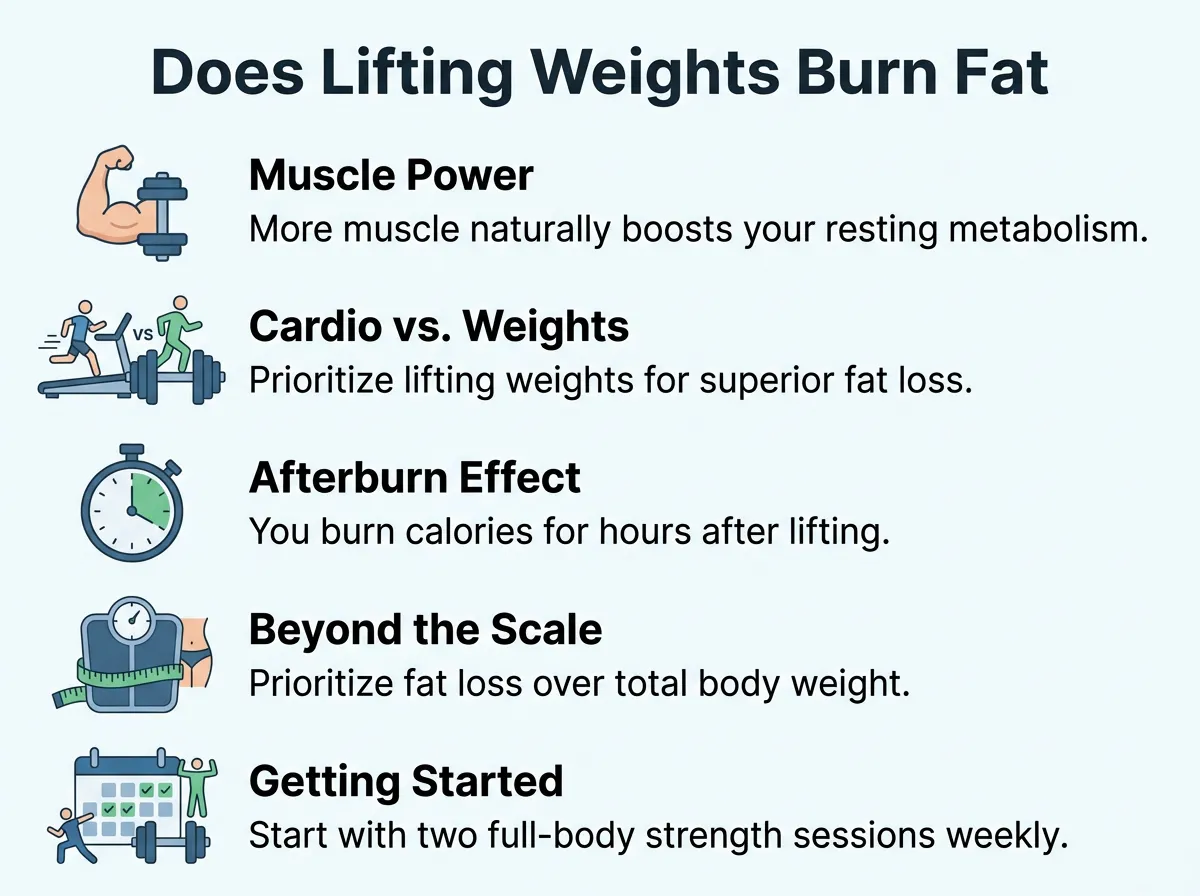
Does Lifting Weights Burn Fat? — key points at a glance
Calories Burned During the Workout
Cardio exercises like running or cycling burn a lot of calories while you do them. If you run for thirty minutes, you will burn a high number of calories. If you lift weights for thirty minutes, you might burn a little less. This leads many to think cardio is the clear winner. But this is only half of the story.
Calories Burned After the Workout
When you finish running, the calorie burn stops almost right away. Your heart rate goes back to normal. Your body stops working hard. But when you lift weights, your body keeps working. It has to repair the tiny tears in your muscles. This process requires a lot of energy. This is why comparing cardio and weight lifting shows that weights have a long-lasting power that cardio lacks.
Understanding the Afterburn Effect (EPOC)
This brings us to a cool scientific concept. It is called Excess Post-Exercise Oxygen Consumption. Most people just call it the afterburn effect.
How Your Body Recovers
When you lift heavy weights, you put stress on your body. Your muscles need to heal. Your body must work hard to bring everything back to balance. It needs to restore oxygen levels. It needs to clear out lactic acid. It also must rebuild muscle fibers. All of this work requires oxygen and energy.
What Science Says About EPOC
The afterburn effect can last for up to 38 hours after your workout. That means you are still burning extra calories the next day. You are burning fat while watching television. You are burning fat while working at your desk. This is why the question “does lifting weights burn fat?” has a strong scientific backing. The continuous calorie burn makes weights highly efficient.
Why Body Composition Matters More Than the Scale
If you only look at the scale, you might get discouraged. Weight training can make the scale stay the same. It can even make it go up slightly. But does this mean you are not losing fat? Absolutely not.
Muscle vs. Fat Density
Muscle is much denser than fat. One pound of muscle takes up much less space than one pound of fat. Think of a pound of feathers versus a pound of gold. The gold is small and heavy. The feathers take up a huge box.
If you lose five pounds of fat and gain five pounds of muscle, your weight does not change. But your body will look totally different. You will look tighter, leaner, and stronger. Your clothes will fit much better.
The Skinny Fat Phenomenon
If you only do cardio and eat very little, you will lose weight. But you will lose both fat and muscle. This can lead to a “skinny fat” look. You might look smaller, but your body may still feel soft. Lifting weights ensures you lose fat while keeping your muscle. This is one of the main health benefits of strength training that keeps your body functional and strong.
How to Get Started with Weight Training for Fat Loss
Starting a new routine can feel scary. You might see big weights and feel lost. But you do not need to lift huge barbells right away. You can start small and still see amazing results.
Focus on Compound Movements
Compound movements are exercises that use more than one joint at a time. They work multiple large muscle groups at once. This means they burn the most calories. Excellent examples of compound movements include:
- Squats: These work your legs, hips, and core.
- Push-Ups: These work your chest, shoulders, and arms.
- Rows: These work your back and biceps.
- Glute Bridges: These work your glutes and hamstrings.
Set a Simple Weekly Routine
You do not need to live in the gym. Aim to lift weights two or three times a week. Give your body a day of rest between sessions. Start with bodyweight exercises or light dumbbells. Focus on your form first. As you get stronger, you can add more weight.
Nutrition: The Fuel for Your Fat Loss Journey
You cannot out-train a bad diet. If you want to burn fat, you must watch what you eat. Lifting weights will boost your metabolism. But you still need to be in a calorie deficit to lose fat.
Try to eat plenty of protein. Protein helps repair your muscles after a hard workout. It also keeps you feeling full for longer. Eat whole foods like vegetables, fruits, lean meats, and whole grains. Avoid sugary drinks and processed snacks.
Conclusion
So, does lifting weights burn fat? The answer is a clear and resounding yes. Weight training is a powerful tool for fat loss. It builds muscle, which boosts your metabolism. It creates a lasting afterburn effect that burns calories for hours. It also reshapes your body, giving you a lean and strong look.
Do not fear the weight room. Embrace it. Start with simple moves and stay consistent. Combine your lifting with good food and plenty of sleep. Soon, you will see your body change in ways you never thought possible.
Frequently Asked Questions
Can beginners burn fat by lifting weights?
Yes, beginners can easily burn fat by lifting weights. In fact, beginners often see rapid changes because their bodies adapt quickly to the new stimulus. Starting with simple movements will help build a strong foundation.
Do I need to lift heavy weights to burn fat?
No, you do not have to lift extremely heavy weights to burn fat. Lifting light or moderate weights with higher repetitions can also burn calories and build muscle. The key is to challenge your muscles consistently.
How often should I lift weights for fat loss?
You should aim to lift weights two to three times per week for fat loss. This schedule allows your muscles enough time to rest and recover between sessions. Consistency is far more important than working out every single day.
Will lifting weights make me look bulky?
No, lifting weights will not automatically make you look bulky. Building bulky muscle requires intense training, heavy weights, and eating a large surplus of calories. For most people, lifting weights results in a lean and toned appearance.
Should I do cardio or weights first?
If your main goal is to burn fat and build strength, you should lift weights first. Doing cardio first can exhaust your energy, leaving you too tired to lift safely. Save your cardio for the end of your session or do it on different days.
How long does it take to see fat loss results from lifting?
You may begin to notice changes in your strength and energy levels within two to four weeks. Visual changes like a leaner body usually appear after six to eight weeks of regular training. Your diet will also play a huge role in how quickly you see results.
