



While walking burns a higher percentage of calories from fat, running burns far more total calories in less time, making it superior for overall weight loss. To maximize your results, choose the workout that matches your fitness level, joint health, and lifestyle. Combining both methods is often the most sustainable way to shed body fat and keep it off.
Imagine walking into a gym or stepping outside on a crisp morning. You see some people walking calmly on the trail, while others are sprinting past, drenched in sweat. You want to lose weight, but you also want to protect your knees and enjoy your workout. You might find yourself asking a very common question: Does Walking Burn More Fat Than Running? It sounds like a simple question, but the science behind fitness can make the answer feel surprisingly tricky.
Fitness advice can be confusing. One trainer tells you to run fast to melt away the pounds. Another tells you that slow, steady walking is the secret key to burning pure fat. It is easy to get stuck in “analysis paralysis” before you even lace up your sneakers. This guide will break down the science of how your body burns energy during different workouts.
We will explore the truth about the fat-burning zone, look at the actual calorie math, and compare walking and running side-by-side. By the end of this article, you will know exactly how to choose the best exercise for your unique body, goals, and lifestyle.
Key Takeaways
- The Fat-Burning Zone Myth: Walking uses a higher percentage of fat for fuel, but running burns more total calories and fat overall.
- Time Efficiency: Running burns roughly double the calories of walking in the exact same timeframe.
- Joint and Injury Risk: Walking is a low-impact exercise that is much easier on your joints and reduces injury risk.
- The EPOC Effect: Running creates a higher post-workout calorie burn, keeping your metabolism elevated for hours.
- Incline Walking Benefits: Adding a hill or treadmill incline to your walk can bridge the calorie gap without the joint stress of running.
- Consistency Over Intensity: The best exercise is the one you enjoy enough to do consistently every single week.
📑 Table of Contents
Understanding the Energy Systems: Fat vs. Carbohydrates
To understand if walking can outshine running for fat loss, we must look at how our bodies create energy. Your body has two main fuel sources: carbohydrates and fats. The fuel your body chooses depends heavily on how hard you are working. When you are sitting, resting, or walking slowly, your body relies mostly on fat for energy. When you start sprinting, your body quickly switches to carbohydrates because they are faster to break down and use.
What is the Fat-Burning Zone?
The “fat-burning zone” is a real biological concept, but it is often misunderstood. It refers to a low-to-moderate intensity workout where your heart rate is around 50% to 70% of its maximum. During this easy pace, your body gets about 60% of its energy from fat stores. In contrast, during a high-intensity workout like running, only about 40% of the energy comes from fat, while the rest comes from carbs.
This difference is why many people ask, Does Walking Burn More Fat Than Running? Since walking keeps your heart rate in that lower zone, you burn a higher percentage of fat. However, looking only at percentages can lead to a misleading conclusion. We need to look at the total picture of energy expenditure during exercise.
Why Total Calories Matter More
While walking burns a higher percentage of fat, running burns far more total calories. To see how this works, let us look at a quick math example. If you walk for 30 minutes, you might burn 150 calories. Since 60% of those calories come from fat, you have burned 90 fat calories. If you run for 30 minutes, you might burn 300 calories. Even if only 40% of those calories come from fat, you have burned 120 fat calories. In the end, running helped you burn more total fat and twice as many total calories.
This is why understanding the difference between walking and running is so important. A higher percentage of a small number is still smaller than a lower percentage of a very large number. If weight loss is your ultimate goal, the total number of calories you burn will always be the most important factor.
Walking vs. Running: The Calorie Battle
When we look at pure efficiency, running is the clear winner for burning calories in a short amount of time. Running requires more effort from your muscles, lungs, and heart. Every step you take while running involves lifting your entire body weight off the ground. This demands a massive amount of energy compared to keeping one foot on the ground at all times while walking. When people ask, Does Walking Burn More Fat Than Running? they often forget that intensity dictates how much energy your body needs.
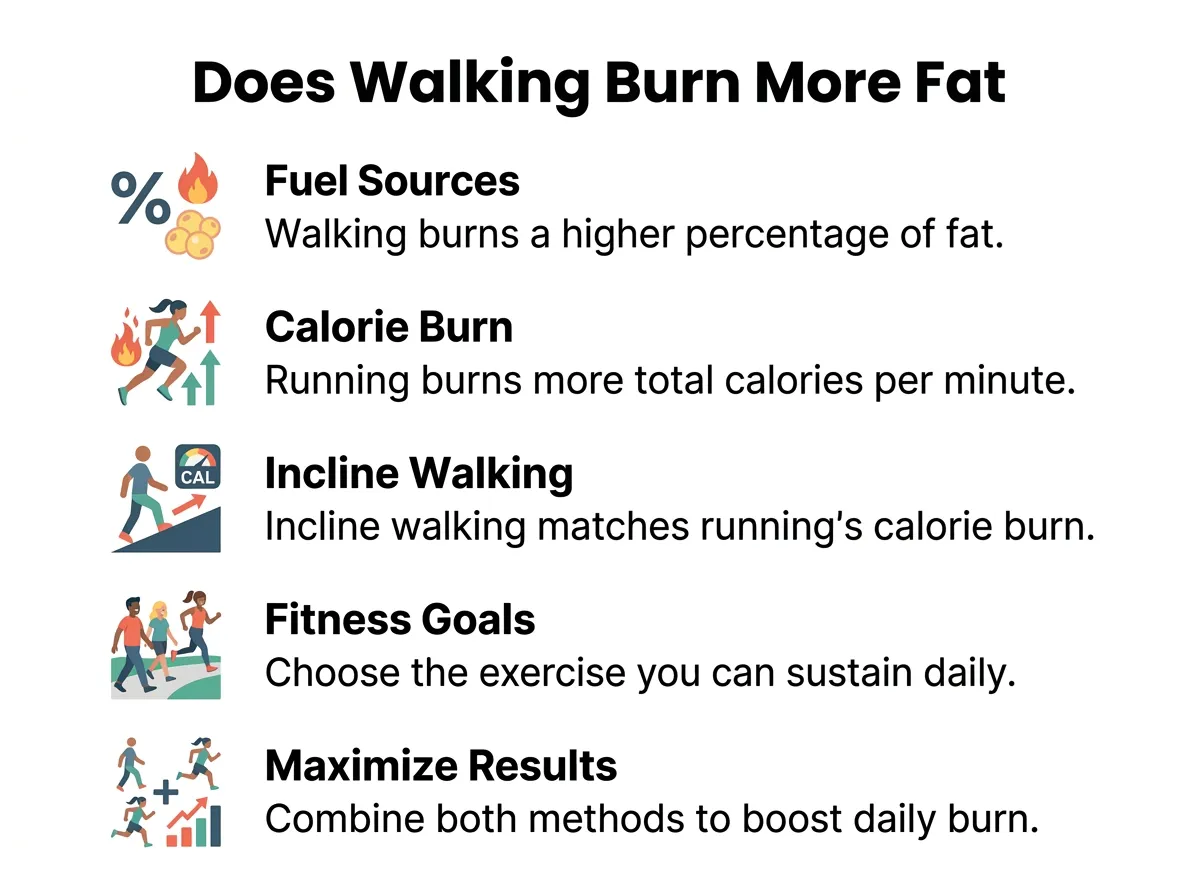
Does Walking Burn More Fat Than Running? — key points at a glance
The Math Behind the Sweat
Let us look at how the calories stack up for an average person weighing 160 pounds. Walking at a moderate pace of 3 miles per hour for one hour burns about 240 calories. Running at a pace of 6 miles per hour for that same hour burns around 650 calories. You would have to walk for nearly three hours to match the calorie burn of a one-hour run. This makes running highly attractive for busy people who want quick results.
If you are looking at a walking vs running comparison, you can see that time is the biggest variable. If you have all afternoon, a long, scenic walk can burn a lot of fat. But if you only have thirty minutes during your lunch break, running will give you a much bigger bang for your buck.
Post-Workout Burn (EPOC)
The calorie burn does not stop the moment you step off the treadmill. High-intensity exercise creates a state called Excess Post-exercise Oxygen Consumption, or EPOC. This is often called the “afterburn effect.” After a hard run, your body must work overtime to cool down, repair muscle tissue, and restore oxygen levels. This process keeps your metabolism elevated, burning extra calories for hours after your workout is over. Walking, because it is low-intensity, produces almost no afterburn effect.
The Hidden Power of Incline Walking
What if you want the high calorie burn of running but hate the joint pain that comes with it? This is where incline walking comes in. By walking up a hill or raising the incline on a treadmill, you can dramatically increase your calorie burn without changing your speed. This is a fantastic middle ground for anyone asking, Does Walking Burn More Fat Than Running?
Stepping Up the Intensity
When you walk on an incline, you are fighting against gravity. Your calves, hamstrings, and glutes have to work much harder to push you upward. According to fitness experts, walking at a steep incline can burn just as many calories as a slow jog. It elevates your heart rate into a cardiovascular zone, helping you burn more total fat and build lower-body strength at the same time.
If you want to know more about this strategy, reading about incline walking vs running reveals that adding steep slopes to your walks can match the fat-burning benefits of a run while keeping your feet planted firmly on the ground. It is an incredibly effective tool for weight loss.
Saving Your Joints
One of the biggest downsides to running is the impact on your body. Every time your foot hits the pavement during a run, your joints absorb a force equal to about three times your body weight. Over time, this can lead to knee pain, shin splints, or ankle injuries. Incline walking gives you the cardiovascular benefits of running with the gentle, low-impact nature of flat walking. It is a win-win for your joints and your weight loss goals.
Which is Better for Your Long-Term Goals?
When deciding between these two exercises, you must look beyond the science of calorie burn. The best workout on paper is useless if you hate doing it. Long-term weight loss depends entirely on consistency. If you force yourself to run but dread every second of it, you will likely quit within a few weeks. Walking, on the other hand, is highly enjoyable and easy to turn into a daily habit. If you are trying to decide, Does Walking Burn More Fat Than Running? for your personal schedule, think about your weekly routine.
Choosing Based on Fitness Levels
If you are new to fitness or carrying a lot of extra weight, walking is the safest and most effective place to start. It builds cardiovascular endurance, strengthens your bones, and prepares your muscles for more intense workouts later on. Starting with running too quickly often leads to pain, burnout, and injury. You can always start with walking and slowly add short bursts of jogging as you get stronger.
For more insights on making this choice, a deep dive into whether running or walking is better for long-term health shows that both offer incredible benefits for your heart, blood pressure, and mental clarity. Choosing the one that matches your current fitness level is always the smartest move.
Consistency and Mental Health
Walking is more than just a physical workout; it is also a powerful tool for stress relief. A calm walk in nature can lower cortisol levels, which is the stress hormone linked to stubborn belly fat. Running can sometimes feel like a chore, whereas a walk is a great time to listen to a podcast, chat with a friend, or clear your mind. Never underestimate the power of an exercise that makes you feel happy and relaxed.
Practical Tips to Maximize Fat Loss
No matter which exercise you choose, there are simple ways to boost your fat loss results. You do not have to settle for basic routines. Here are some practical tips to help you get the most out of your workouts:
- Try Interval Training: If you walk, try adding a 30-second jog every five minutes. If you run, mix in short sprints followed by recovery walks. This keeps your body guessing and boosts your post-workout calorie burn.
- Use a Weighted Vest: Adding a small amount of extra weight while walking increases the workload on your muscles, helping you burn more calories without joint strain.
- Track Your Steps: Aim for a daily step goal, like 8,000 to 10,000 steps. Keeping active throughout the day is often more effective than doing one short workout and sitting for the rest of the day.
- Walk After Meals: A short 10-minute walk after eating helps lower blood sugar spikes and aids digestion, which supports your weight loss efforts.
Conclusion
So, Does Walking Burn More Fat Than Running? The answer is a mix of science and lifestyle. Walking burns a higher percentage of fat per minute, but running burns more total calories and more total fat because of its high intensity. However, the perfect exercise is the one you can stick with week after week. If you love the peace of walking, keep walking! If you want to burn calories quickly and enjoy the challenge, choose running. You can even combine both to create a fun, joint-friendly routine that keeps you moving toward your weight loss goals happily and safely.
Frequently Asked Questions
Can I lose weight just by walking?
Yes, you can absolutely lose weight by walking consistently. To maximize weight loss, combine your daily walks with a healthy, calorie-controlled diet. Walking is easy on the joints, making it highly sustainable for long-term weight management.
How many calories does walking on an incline burn?
Walking on an incline can burn up to 60% more calories than walking on a flat surface. Raising the incline forces your muscles to work harder, which raises your heart rate to levels similar to jogging. This makes incline walking an incredibly efficient way to burn fat without high joint impact.
Is it better to walk or run for belly fat?
Both walking and running can help reduce belly fat, but running burns more total calories, which can speed up overall fat loss. However, walking is excellent for reducing stress hormones like cortisol, which are directly linked to holding onto belly fat. Combining both approaches yields the best results.
How long should I walk daily for fat loss?
Aim to walk for 30 to 45 minutes daily to promote steady fat loss. Doing this most days of the week helps create a consistent calorie deficit while keeping your body active and energized. If you are short on time, even a brisk 15-minute walk offers great metabolic benefits.
Does running cause more injuries than walking?
Yes, running has a significantly higher injury rate than walking because of the high impact on your joints. Running subjects your knees, shins, and ankles to repetitive force, whereas walking keeps one foot on the ground at all times to minimize stress. If you have joint pain, walking or incline walking is much safer.
Can I combine walking and running in the same workout?
Absolutely, combining the two is known as interval training and is highly effective for burning fat. You can walk for three minutes to warm up, jog for one minute, and repeat this cycle throughout your workout. This approach builds cardiovascular endurance without overly exhausting your body.
