



To burn fat most efficiently, you should aim to keep your heart rate between 60% and 70% of your maximum heart rate. At this moderate level of effort, your body primarily uses stored fat for fuel instead of quick sugars. You can easily find your personal target zone by subtracting your age from 220 and multiplying that number by 0.60 and 0.70.
Picture this. You are on the treadmill at the local gym. You are sweating, breathing heavily, and staring at the flashing screen on the console. You see numbers for speed, distance, and calories. Then, you see your pulse. You wonder if you are pushing yourself too hard, or maybe not hard enough. You want to lose weight, but you might find yourself wondering: What Heart Rate for Fat Burn is truly best?
It is easy to get lost in the numbers. Fitness machines have colorful charts that show different training zones. Some zones say “cardio,” while others say “fat burn.” When searching for What Heart Rate for Fat Burn, it helps to understand how your body uses energy. It is not just about working as hard as you can. Sometimes, working a bit smarter and slower is the real key to success.
This guide will break down the science of heart rates in simple terms. We will look at how your body burns fuel. You will learn how to find your own magic numbers. Plus, we will share simple tips to get the most out of every workout session.
Key Takeaways
- The Sweet Spot: Your ideal fat-burning zone is 60% to 70% of your maximum heart rate.
- Simple Math: Calculate your maximum heart rate by subtracting your age from 220.
- Fuel Sources: Lower intensity workouts burn a higher percentage of fat, while high-intensity workouts burn more total calories.
- The Talk Test: You can check your intensity by speaking; you should be able to talk but not sing during a moderate workout.
- Consistency Wins: Staying active regularly matters more than hitting the perfect heart rate number every single second.
📑 Table of Contents
Understanding Your Heart Rate Zones
Your heart is an amazing pump. It beats faster when you move to send oxygen to your muscles. Your heart rate is the number of times your heart beats in one minute. Exercise scientists divide these beats into five distinct zones. These zones range from very light activity to maximum effort.
What Are Heart Rate Zones?
Each zone is a percentage of your maximum heart rate. Zone 1 is very light, like a slow walk. Zone 2 is a light jog where you can still talk easily. Zone 3 is moderate effort. Zone 4 is hard work where you breathe fast. Zone 5 is your absolute maximum effort, like a short sprint. For most people, understanding the math behind What Heart Rate for Fat Burn is essential to finding the right zone.
The Myth of the “Fat-Burning Zone”
The traditional “fat-burning zone” is usually Zone 2. In this zone, your body gets about 60% of its energy from fat. In higher zones, your body relies more on carbohydrates. This sounds simple, but there is a catch. According to the experts at the Cleveland Clinic, high-intensity workouts burn more total calories. Even if the percentage of fat burned is lower, the total amount of fat lost can be higher because you did more total work. Both methods are useful for weight loss.
How to Calculate Your Fat-Burning Heart Rate
You do not need a science degree to find your personal target. You just need some basic math. If you ask a trainer, “What Heart Rate for Fat Burn do I need?” they will likely start with a simple formula.
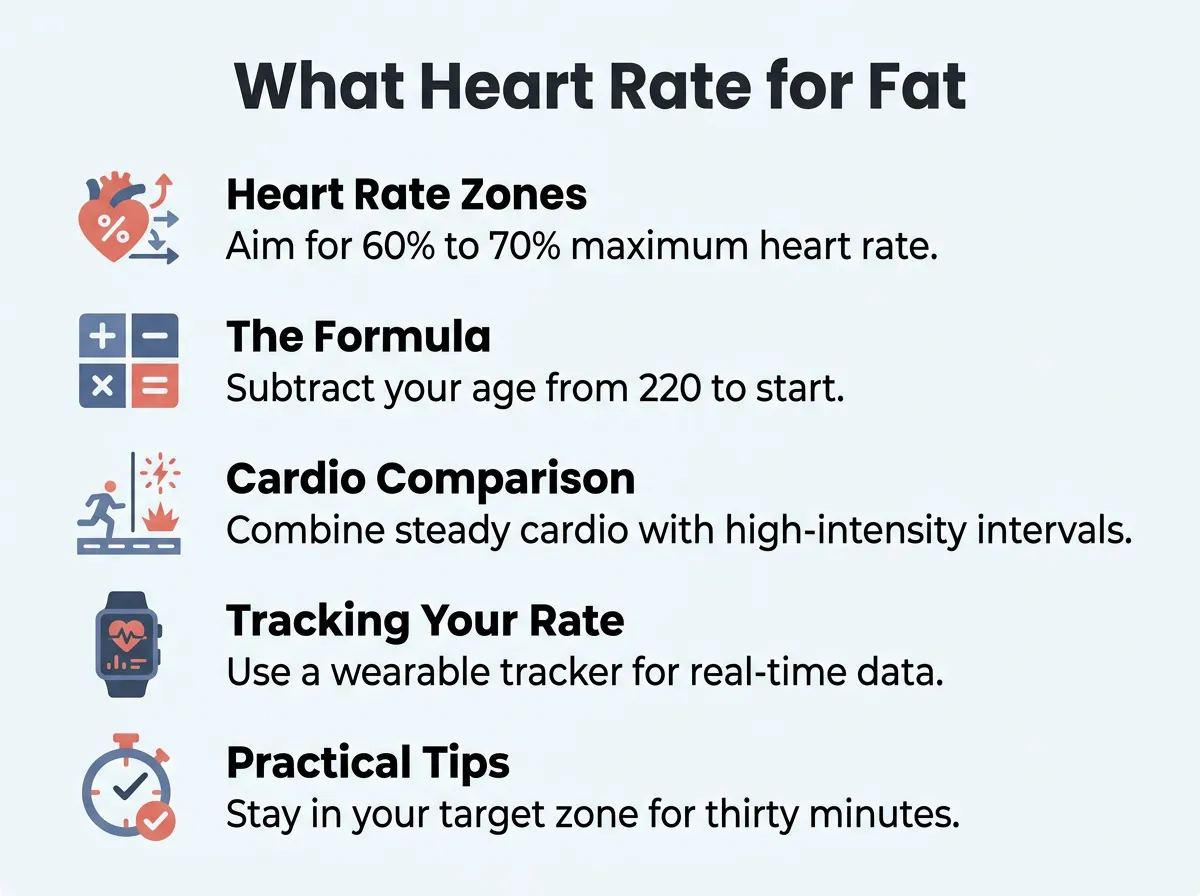
What Heart Rate for Fat Burn? — key points at a glance
The Basic Formula
First, you must estimate your maximum heart rate. The easiest way to do this is to subtract your age from 220.
For example, if you are 40 years old, your math looks like this:
220 – 40 = 180 beats per minute (bpm).
This number, 180, is your estimated maximum heart rate.
Calculating the Target Range
Once you have your maximum, you can find your target zone. The fat-burning zone is 60% to 70% of your maximum.
Using our 40-year-old example:
- Low end: 180 x 0.60 = 108 bpm
- High end: 180 x 0.70 = 126 bpm
This calculation gives you a clear answer to What Heart Rate for Fat Burn works for your body. For this 40-year-old, keeping the pulse between 108 and 126 bpm is ideal for steady fat loss.
High-Intensity vs. Low-Intensity Cardio
Now that you know your numbers, you might wonder how to design your workouts. When looking at What Heart Rate for Fat Burn, we have to compare different styles of exercise. There are two main paths you can take.
The Case for Steady-State Cardio
Steady-state cardio involves keeping a constant pace for a longer time. Think of a brisk walk, a light bike ride, or an easy swim. This type of exercise keeps you right in that 60% to 70% zone. It is gentle on your joints. It builds your aerobic endurance. Best of all, you can do it for a long time without feeling exhausted. It is a highly sustainable way to burn fat.
The Power of HIIT
High-Intensity Interval Training, or HIIT, is different. You work very hard for a short time, then rest. Your heart rate spikes into Zone 4 or 5, then drops. As detailed by WebMD, HIIT raises your metabolism for hours after your workout is over. This is called excess post-exercise oxygen consumption, or the “afterburn effect.” It is a great option if you are short on time.
Simple Ways to Measure Your Heart Rate
Tracking What Heart Rate for Fat Burn requires the right tools. You do not need to spend a fortune, but having a way to monitor your pulse can keep you on track.
Using Fitness Trackers and Smartwatches
Smartwatches and fitness bands are very popular today. They use light sensors to read your pulse right from your wrist. These devices are very convenient. They can show you your heart rate in real-time. According to Healthline, while wrist trackers are generally accurate for steady exercise, they can sometimes lag during quick sprints. For most people, though, they are more than accurate enough.
The Talk Test
What if you do not have a smart device? You can use a free, simple tool called the “Talk Test.” This is based on how easily you can speak while moving.
- Low intensity (Warm-up): You can sing a song easily.
- Moderate intensity (Fat-Burn Zone): You can talk in full sentences, but you cannot sing.
- High intensity (Cardio/HIIT): You can only say a few words before pausing for breath.
Practical Tips to Maximize Your Fat Burn
To apply the concept of What Heart Rate for Fat Burn to your routine, you need a plan that fits your life. Here are a few practical tips to help you succeed.
Mix Your Methods
You do not have to choose between slow walks and intense sprints. The best routine combines both. Try doing steady-state cardio two or three times a week. Add one or two short HIIT sessions when you have less time. This keeps your workouts fun and challenges your body in different ways.
Start Slowly
If you are new to exercise, do not worry about hitting high numbers right away. Focus on consistency. A 20-minute walk at a moderate pace is a fantastic start. As your heart gets stronger, your resting heart rate will drop. You will find that you can move faster with less effort.
Staying Safe and Listening to Your Body
Knowing What Heart Rate for Fat Burn is great, but safety comes first. Your body will always tell you if something is wrong. Formulas are just estimates. Your actual limits might be slightly different.
Signs You Are Pushing Too Hard
If you feel dizzy, lightheaded, or have chest pain, stop exercising immediately. Extreme shortness of breath is also a sign to slow down. Exercise should feel challenging, but it should never feel painful or scary.
Rest is Key
Your muscles need time to recover. If you exercise too hard every day, your body gets stressed. This can actually make it harder to lose weight. Aim for at least one or two rest days each week to let your body rebuild and grow stronger.
Conclusion
Finding the right intensity for your workouts does not have to be a guessing game. By calculating your personal target zone, you can work out with confidence. Keep your heart rate around 60% to 70% of your maximum for steady, comfortable fat burn. Mix in some higher-intensity days if you want to boost your fitness. Most importantly, find activities you enjoy. When you love your workouts, staying active becomes easy, and you no longer have to guess What Heart Rate for Fat Burn is right for you. Get out there, move your body, and enjoy the journey!
Frequently Asked Questions
What is the fat-burning heart rate zone?
The fat-burning zone is a level of exercise intensity where your heart rate is at 60% to 70% of its maximum. At this level, your body naturally uses a higher percentage of fat for fuel. It is a moderate intensity where you can talk but not sing.
How do I calculate my personal fat-burning heart rate?
First, subtract your age from 220 to find your maximum heart rate. Then, multiply that number by 0.60 and 0.70 to find your target range. For example, a 30-year-old would aim for a heart rate between 114 and 133 beats per minute.
Is walking enough to get into the fat-burning zone?
Yes, a brisk walk is often enough to reach this zone, especially if you are new to exercise or walking uphill. The key is to walk fast enough to raise your breathing rate while still being able to hold a conversation. It is a highly effective, low-impact way to burn fat.
Is it better to exercise in the fat-burning zone or the cardio zone?
Both zones have unique benefits for your body. The fat-burning zone is great for longer, sustainable workouts and uses fat as its main fuel source. The cardio zone burns more total calories in a shorter time, which also helps with overall weight loss.
Can I burn fat if my heart rate is above the fat-burning zone?
Yes, you will still burn fat during high-intensity exercise. While your body uses more carbohydrates for quick energy during intense workouts, you burn more total calories overall. This leads to a high amount of total fat loss over time.
How long should I stay in my fat-burning heart rate zone to lose weight?
Aim to stay in this zone for 30 to 60 minutes per session. Doing this three to five times a week can create a healthy calorie deficit. Always pair your workouts with a balanced diet for the best weight loss results.
